Cellar Sign Studio · buyer guide
Bilingual tasting-room signs
For Cellar Sign Studio worldwide orders, translate the approved guest instruction or descriptive content that the audience needs, while preserving official wine and venue names unless an authorized alternate form exists. Treat each field by purpose. A bilingual heading can help guests understand a menu, but it should not create a new product identity or change a vintage reference.
Reviewed 2026-09-05 · AI-assisted editorial review. General buying guidance; illustrative scenarios are not customer case studies. Images are AI-generated concepts.
Start with a meaning brief that explains what the guest should learn or do. Is the sign naming the tasting menu, identifying a service point or describing an approved flight? Give that context to the language reviewers so they are not translating isolated words without knowing their function.
Ask the venue owner which names are official and which phrases are descriptive. Keep those instructions visible in the copy sheet. Production should not translate a producer name automatically or leave a necessary guest instruction untranslated merely because both appear in the same artwork file.
Who should approve each language version?
Assign a competent reviewer for each language and a venue owner for product names, vintage details and the intended guest action. These reviewers answer different questions. A fluent phrase can still describe the wrong wine, while a correct product record can still be presented in unclear language for the intended audience.
Provide the complete phrase and its placement context. A term used as a menu heading may not work the same way as a short directional label. Ask reviewers to approve exact visible text, including accents, punctuation and capitalization.
Machine-generated translations can be treated as drafts if the venue chooses, but they should not become released signs without the designated review. The maker should receive accepted text and identify layout constraints, rather than becoming the final authority on the venue's language or beverage description.
How should two languages share the physical space?
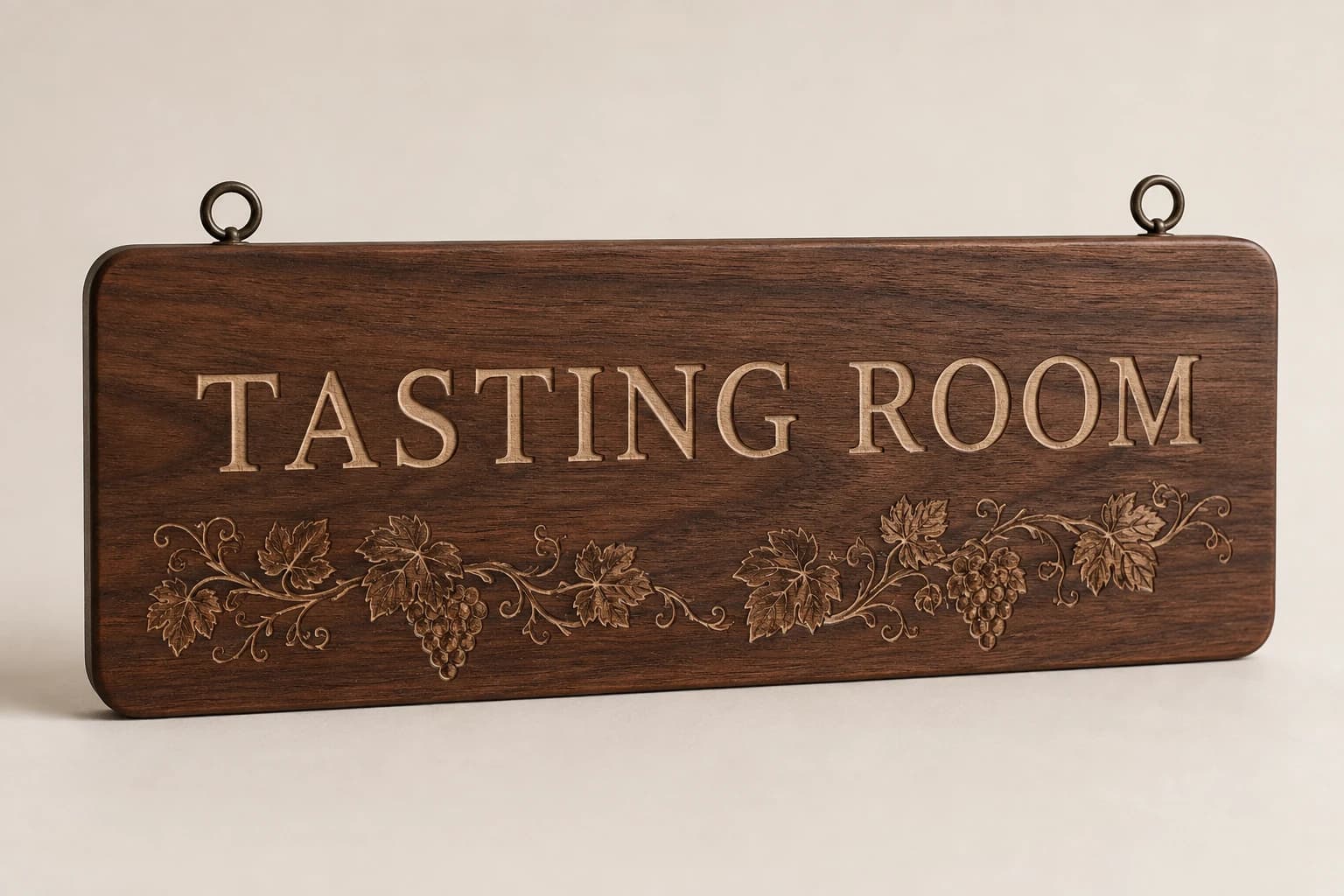
Choose the language order and intended prominence before fitting the text into the sign. Review both versions together at actual size. Different line lengths may require deliberate spacing or line breaks; they do not automatically justify making one language much smaller or deleting words without approval.
Ask the designer to use the actual approved strings, especially for long names or scripts with marks that need careful reproduction. A short placeholder pair can hide the layout challenge. The language reviewer should inspect the finished artwork representation as well as the source text.
If the chosen format cannot present both versions clearly, compare a larger usable area or separate coordinated displays. That changes the physical scope and may change quantity. The venue should approve the resulting approach rather than treating a compressed translation as the only way to keep the original product choice.
Illustrative example: How do two tasting-menu headings total twenty-four characters?
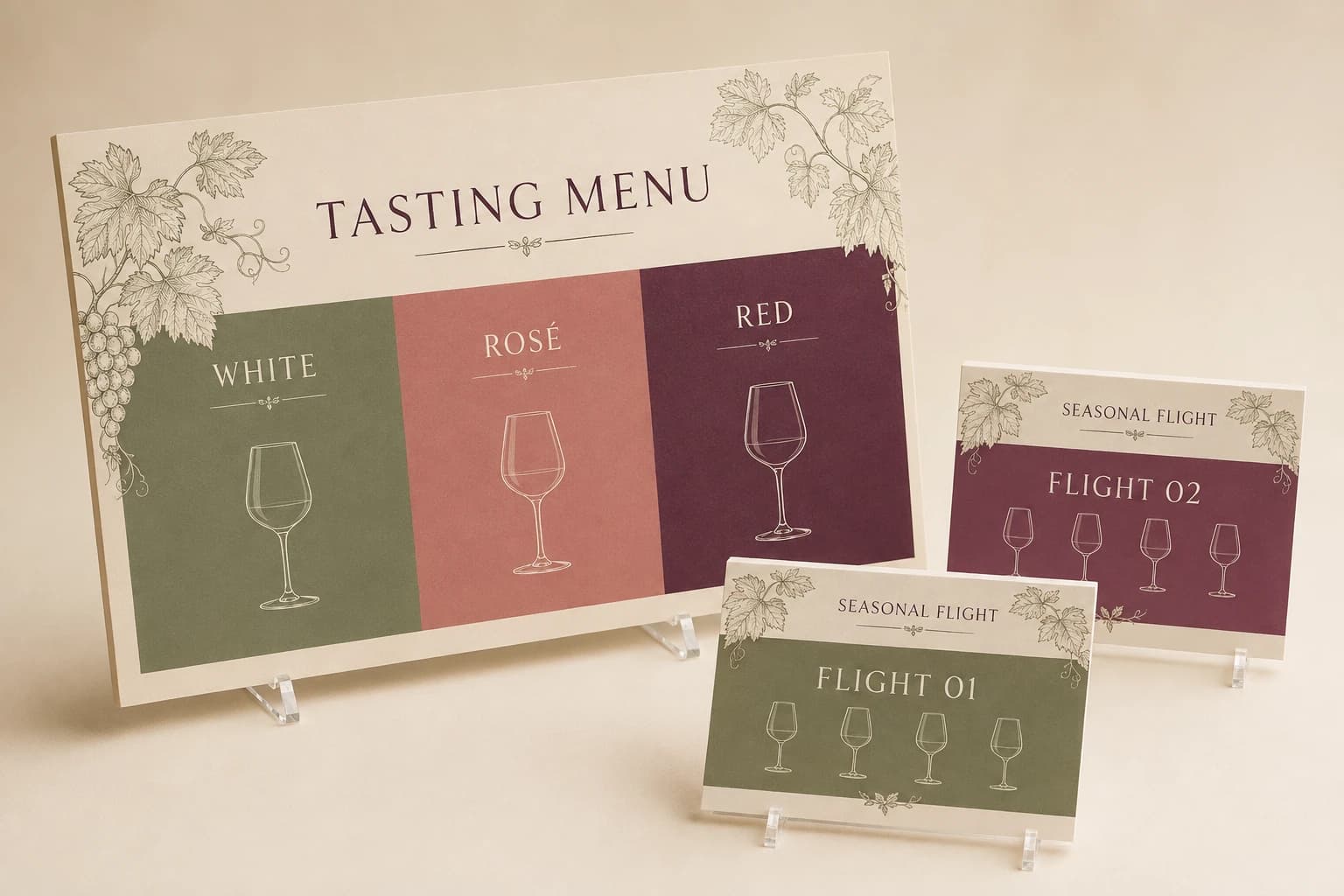
The fictional example uses Tasting Menu and Menu de cata as two sample heading lines. Each line has twelve characters including spaces, so the total is twenty-four across two lines. With an eighteen-character budget, both are within the entered limit. This is a text count, not translation or physical-fit approval.
Tasting contains seven letters, followed by a space and Menu with four. Menu de cata contains four letters, a space, two letters, another space and four letters. The worksheet labels both strings SAMPLE and leaves language and layout approval on HOLD.
A venue may choose different wording for its audience after review. If that changes the length, rerun the check and inspect the revised complete proof. Do not retain an inferior phrase solely because the first sample fit the numerical budget. The wording should serve the guest action the sign was created to support.
How do wine names, vintages and prices stay consistent?
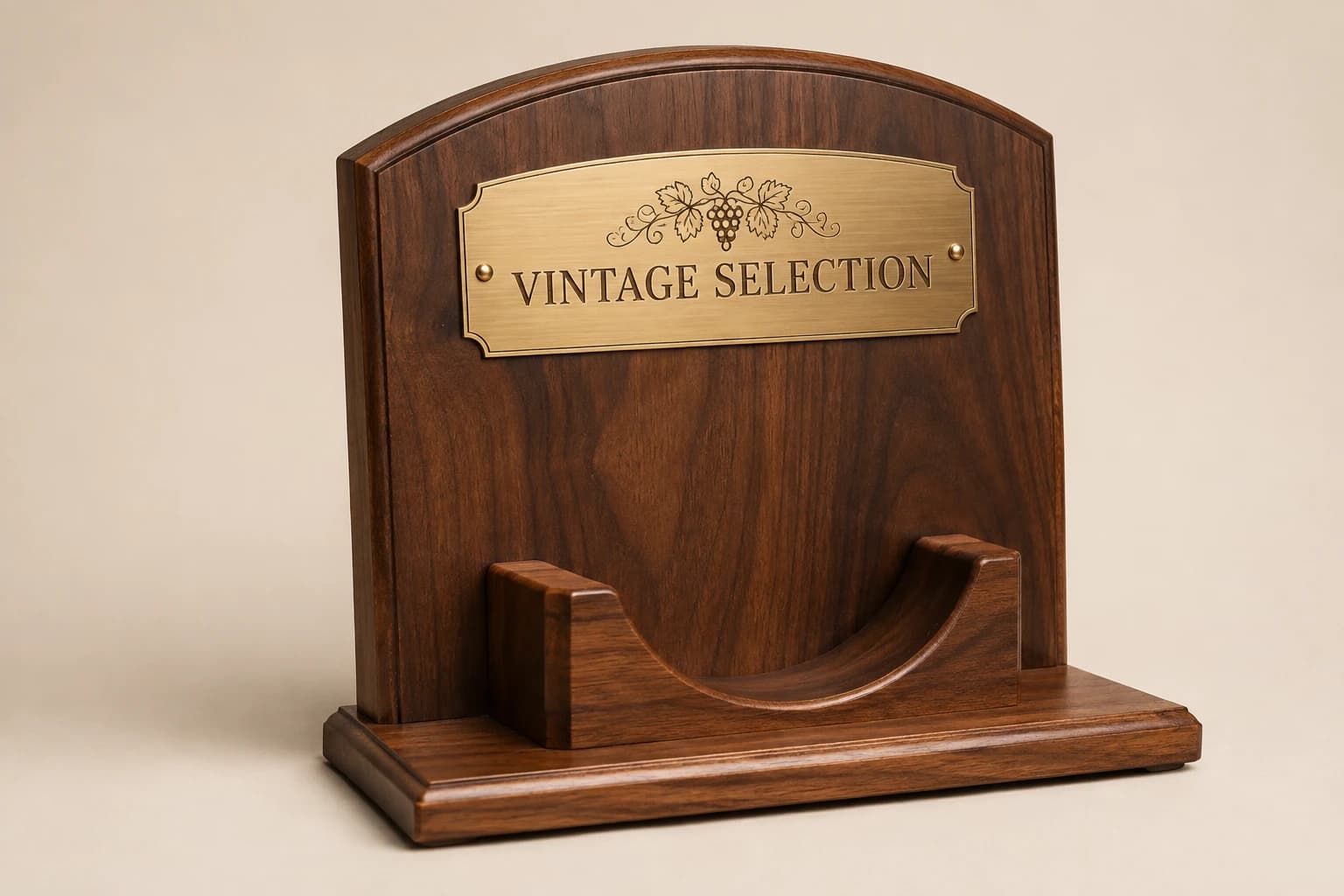
Keep product names, vintage references and any displayed prices in separate approved fields linked to both language versions. A language change should not convert a price, alter a year or substitute a different wine. The venue owner should approve those content values before the paired layout is released.
If a descriptive tasting note is included, ask the venue to confirm the intended statement and the language reviewers to preserve its meaning. Do not invent flavor, origin or production claims to make the translated copy sound richer. The display can be concise when the approved information is limited.
For changing menus, use a revision reference that covers both languages. When one wine is replaced, identify all affected captions and descriptions. A correct bilingual heading does not make an outdated vintage or price underneath it correct.
Check a paired tasting-menu heading
Load the fictional worked example, then replace every assumption with your approved project inputs.
Method: Count characters including spaces by line. The tool does not validate translation, product claims or physical fit.
Build your plan
Counts include spaces and punctuation. Character count cannot establish physical fit: font, script, layout, material and engraving area require a proof at actual size.
Use the article’s example files
Fictional example rows show how to separate physical quantities, wording and approval references. Replace them with your project schedule. HOLD and SAMPLE entries are not production instructions.
What should the quote and final review include?
The quote should state the physical sign count, languages, approved text scope, proposed layout work and included supports or holders. Confirm whether translation services are included or supplied by the venue. Compare written prices per physical deliverable, with separate artwork work visible rather than assuming a second language is an unpriced automatic addition.
At final review, ask both language reviewers to inspect the assembled proof and the venue owner to confirm the product and guest-action content. Then verify the actual received text against that selected revision. Keep marks and line breaks in the receiving check, not only the largest words.
For the next Cellar Sign Studio request, reuse the approved language relationship while obtaining fresh content approval for new wines or instructions. A consistent visual system can save clarification, but it should not turn a previous translation into blanket approval of every future tasting-room phrase.
How should language versions be retained?
Keep the approved language pair connected to one sign reference and selected layout. When a menu or guest instruction changes, identify both language versions for review. Updating only the first language can leave the other describing an older tasting offer or a different guest action.
For a later Cellar Sign Studio order, provide the current paired text and any approved product names that must remain unchanged. Do not assume a translator should reinterpret the winery name or a bottle label simply because the previous file has a blank second-language field.
How should a bilingual menu change be released?
Release the current language pair as one selected content set while retaining each reviewer’s approval. A wine substitution can affect a name, description and vintage line in both versions. The coordinator should identify those dependent fields rather than replacing only the first language and leaving the companion display outdated.
Use an exact change record with the old approved item, new approved item and affected physical locations. Ask language reviewers to inspect the complete revised phrase in context. A product name that remains unchanged may still sit beside a newly translated description, so the whole relationship needs review.
At receiving, compare the paired proof revision rather than checking only the largest heading. If an older insert remains in storage, mark its status through the venue's own process. The next person updating a tasting station should be able to tell which language pair is current without relying on memory of the last menu meeting.
Which option fits this order?
Choose the language treatment according to the guest task and the status of each field. Official names, descriptive instructions and changing menu values require different approvals. The complete physical layout should preserve those distinctions while allowing both language versions to be read and checked in their intended context.
| Option | Useful when | Scope to resolve |
|---|---|---|
| Paired translated instructions | Both language groups need the same guest action at one point. | Meaning, exact strings, order and actual-size layout. NMSU discusses tasting menus and wine identification. |
| Official names with translated headings | Product identity remains fixed while the category or action is explained. | Which names stay unchanged and which phrases are descriptive. |
| Separate coordinated displays | The physical setting or text length supports distinct sign placements. | Two physical quantities, matching current content and approved locations. |
Sources: New Mexico State University: Design and Functionality of a Wine Tasting Room
What should buyers confirm before ordering?
Bilingual tasting information needs approved product fields and a reviewed language pair. Physical quantity, translation responsibility and layout work should be clear in the quote. These answers explain official names, longer lines and menu revisions so a fluent heading does not conceal an outdated vintage, changed price or unapproved product description.
What changes the cost of bilingual tasting-room signs?
Cellar Sign Studio quotes should identify the number of physical signs, languages, supplied or commissioned translation work, layout revisions, construction and delivery. A second language can change artwork scope or the required display area. Ask for those items in writing rather than assuming a per-sign price includes every language service.
Should wine names be translated?
Use the venue-approved product identity. Some descriptive wording may be translated, while official producer or wine names may remain unchanged. Have the venue owner identify the intended treatment explicitly. A language reviewer should not create a different product name simply to make the menu sound more natural.
Does the example approve Menu de cata for every venue?
No. The phrase is an illustrative text-count input. A competent reviewer should approve the wording for the actual audience, meaning and sign placement. The calculator only counts characters and cannot determine whether a translation is the best choice for a particular tasting experience.
Can both languages use the same artwork revision number?
Yes, when the revision identifies the complete approved paired proof. Keep the underlying language strings traceable so a change can be reviewed correctly. If one version changes, inspect the assembled layout again rather than leaving the companion language attached to an older menu or instruction.
What happens when the translated line is longer?
Review the actual-size layout and compare a different line arrangement, larger usable area or separate display. Obtain approval before shortening meaning. A numerical line budget is a review aid, not a rule that lets production delete words or make one language unreadably small.
Sources and scope
The sources below support the cited technical details. The ordering workflows are editorial recommendations. Your project specification, price and schedule are established in the written quote and approved proof.
- New Mexico State University: Design and Functionality of a Wine Tasting Room · checked 2026-09-05
Which buying guide should you read next?
All buying guidesCellar Sign Studio helps buyers distinguish a lasting winery identity piece from a tasting menu that must change with the offer. For worldwide orders, specify the stable venue wording, the replaceable menu content and the physical display separately. One attractive design should not force a whole sign replacement whenever a flight changes.
Cellar Sign Studio tasting-room sign schedules should begin with the next action a guest needs to take, then assign a physical display to the approved location. For worldwide projects, separate arrival, tasting and checkout information from decorative venue identity. Count the resulting pieces after the guest path and current content are reviewed.